


Tillandsia Reilly's Best
Tillandsia Reilly's Best
Couldn't load pickup availability
Acerca del producto
IRRIGATION
IRRIGATION
LIGHTING
LIGHTING
Humidity
Humidity
TEMPERATURE
TEMPERATURE


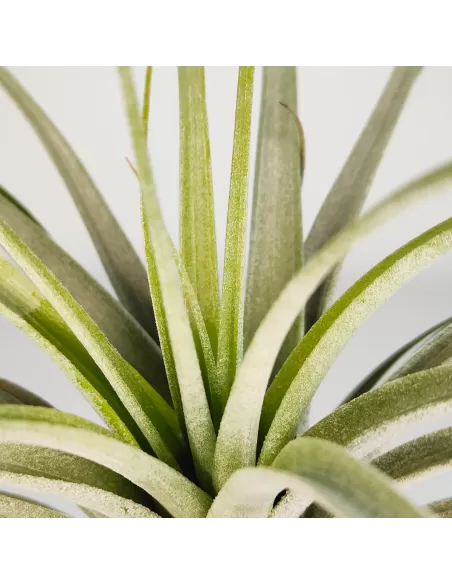
Tillandsia Reily’s Best
The Tillandsia Reily’s Best (Caput Medusae x Streptophylla) is an ornamental hybrid highly valued for its sculptural form and twisted leaves, which give it an exotic and very striking appearance within the Tillandsia genus.
It develops an open and dynamic structure, formed by thick leaves, wide at the base and strongly curved or twisted, inheriting the best of its parents. These leaves feature a surface covered in silvery trichomes, which give it a soft grayish tone and a slightly velvety texture.
Its shape is reminiscent of a structure in motion, with leaves that arch and curve in different directions, making it a very decorative plant even without flowering. It is ideal for focal pieces, striking displays, or collections, where its silhouette stands out on its own.
It has a moderate growth rate and, after flowering, can develop pups at the base, forming clusters over time that increase its volume and visual appeal.
During flowering, it produces a central inflorescence with reddish or pinkish bracts, from which emerge tubular flowers in violet or purple tones, creating a very vivid contrast with its silvery foliage and twisted shape.
Thanks to its twisted structure, its thick and curved leaves, its silvery coloration, and its striking flowering, the Tillandsia Reily’s Best is an ideal choice for those looking for an air plant with character, volume, and a very sculptural style.
Technical Sheet
Scientific name: Tillandsia ‘Reily’s Best’
Family: Bromeliaceae
Origin: Cultivated hybrid
Type: Hybrid
Parents: Tillandsia caput-medusae x Tillandsia streptophylla
Watering: Moderate
Sun: Bright light / tolerates soft sun
Location: Bright indoor or protected outdoor
Flowering: Reddish or pinkish bracts with violet or purple tubular flowers
Fragrant flowering: No
Humidity: 50–70% (min 40 / max 80)
Temperature: 15–30°C (min 10 / max 35)
Drought tolerant: Moderate
Tolerates cool and humid weather: Yes, with ventilation
Suitable for terrarium cultivation: Not recommended
Ideal for beginners: Yes
Rare Tillandsia: Yes